

Running legal team workshops effectively is an essential skill for legal project managers and legal…

Law firm profitability flywheel
Introducing the law firm profitability flywheel
Law firms face unrelenting pressure including, for example:
- clients demanding greater clarity, certainty and cost effectiveness
- regulators emphasising transparency, and
- competitors constantly updating their legal service delivery capability.
Surprisingly, despite market changes such as those referred to above, most firms still treat legal service pricing, delivery, and process improvement as separate disciplines.
We don’t believe they are separate. They are three sides of the same profitability triangle.
In our view, law firms must integrate their approaches to pricing, delivery and process improvement if they are to remain competitive.
By integrating these three components successfully law firms will have built their own profitability flywheel.
Why integration matters
An initially attractive price will not work for anyone if the legal work is done inefficiently throughout the matter lifecycle.
Conversely, even a properly managed matter will lose the firm money if it was under-priced at the start.
And even the best internal processes are wasted if the resulting data never feeds back into future pricing and matter management improvements.
When pricing, project control and process improvement operate in isolation, firms suffer familiar problems such as matter scope creep leading to write-offs, cash-flow pressure and often, client dissatisfaction.
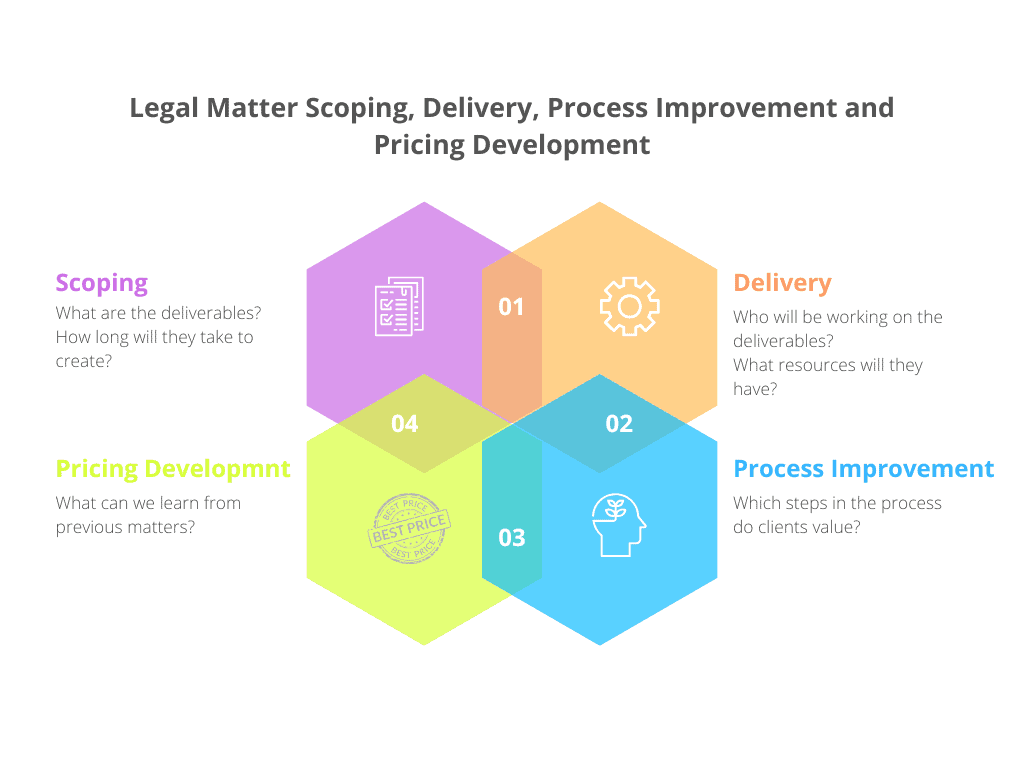
Integrating the three disciplines closes the loop—creating a continuous cycle of confident
- Scoping
- Delivery
- Process improvement
- Pricing development.
Legal Services Pricing
Our preferred approach is value pricing: aligning fees with the outcomes a specific client values in a specific matter, not pricing (and billing) according to how many hours recorded on the matter.
Value pricing requires clarity of scope, assumptions and exclusions.
These are the same foundations required for good project planning.
Hence the natural bridge from legal service pricing to the discipline of legal project management (LPM).
LPM promotes a structured approach to matter management, such as that set out by the International Institute of Legal Project Management (IILPM) in its 4-phase LPM framework.
Much the same holds true when considering other pricing models, such as fixed, staged, or success-based, pricing and it also applies to the standard hourly rate model.
Legal Project Management – delivering on the promise
Every instruction is a project. It has objectives, milestones, dependencies, and risks. LPM equips lawyers to manage these proactively rather than reactively.
Through lightweight planning, communication cadences and budget tracking, LPM converts an agreed price into controlled delivery.
Firms adopting LPM cope better with the inevitable scope changes and work more productively with, and on behalf of, clients. Often both also translate into improved realisation rates.
Applying LPM principles also satisfies modern client-panel requirements for matter transparency, enhances compliance with the SRA’s Code of Conduct, and supports proportionate, evidence-based cost recovery under the Civil Procedure Rules (Parts 3 and 44).
Legal Process Improvement (LPI)– embedding efficiency
Where LPM governs a single matter, LPI examines how the firm repeatedly delivers similar matters.
Borrowing from Lean and Six Sigma disciplines, LPI techniques can be used to map the value stream from instruction to invoice, eliminating waste and delay.
The benefits are real:
- Shorter cycle times and reduced lock-up
- Lower cost-to-serve and improved utilisation
- Easier onboarding of new staff through documented workflows
- Data-driven insight into profitability by matter type and client segment.
Importantly, LPI turns continuous improvement into a cultural norm rather than a one-off exercise.
The profitability flywheel
When the three disciplines of pricing, LPM and LPI run together, they reinforce each other:
1. Pricing defines the commercial objective, sets the budget and aligns value with the client
2. Project management keeps scope, communication and resourcing aligned
3. Process improvement captures the learning, enabling better scoping, sharper future pricing and repeatable success
The result is a self-propelling profitability flywheel that reduces write-offs, increases recovery rates, and enhances client satisfaction – all while lowering stress for partners and teams.
Start building your own profitability flywheel
Some tips, based on experience, about how to start building your profitability flywheel:
- Create a project designed to test the feasibility of developing your own flywheel. Remember the primary purpose of the feasibility project is to learn lessons and get buy-in for further development.
- Identify matter type or practice group, which appears most likely to yield positive outcomes from the feasibility project. Usually this means tapping into the latent enthusiasm to do this by someone senior in the organization.
- Establish a cross-functional team combining finance, operations and fee-earners.
- Start to apply each side of the flywheel in small steps such as by
- Establishing a more overt structural approach to matter management, perhaps by adopting the IILPM’s 4-phase LPM framework
- Examine some well-known workflows used by the team or group and look to reduce the number of steps (activities) required to complete the workflow
- Review past pricing practices per matter type and, using PMS data, consider how your firm can move away from the default billable hour to more profitable pricing methods.
- Most importantly, at the end of the feasibility project conduct a project review. Identify what worked well and what worked not so well. See how you can build on your successes to develop your flywheel further, so that its principles and supporting techniques become embedding the firm’s business as usual practices.
In our experience, within a quarter, most firms see measurable gains in margin, client satisfaction and staff engagement.
Interested in finding out more?
Please contact us to discuss how our legal pricing, project management and process improvement training and consultancy services can help you develop your career and increase your law firm’s profitability.
Please also note this article was written largely by Richard Allen, with some input from Antony Smith.
Related Posts